What Is a Landing Page? A Simple Definition With Real Examples
A landing page is a focused page built to get one action. Here is a simple definition, real examples, the main sections to include, and the mistakes that usually hurt conversions.
A landing page is not just any page on a website. It is a focused page built to get a visitor to take one specific action.
That action might be starting a free trial, booking a demo, requesting a quote, downloading a checklist, buying a product, or running a landing page audit. The exact goal changes by business. The structure does not: a landing page exists to move one visitor toward one next step.
The confusion usually comes from the fact that people use the term loosely. A homepage can receive traffic. A pricing page can receive traffic. A blog post can receive traffic. But a true landing page is usually narrower, more intentional, and less distracted than any of those.
If you are trying to understand whether your page is actually a landing page, this guide gives the simple definition, shows real page patterns, and breaks down the sections that help the page convert.
If you are already getting clicks but not enough signups, demos, or sales, the definition matters because it changes how you write the hero, how many CTAs you show, and how much competing navigation you leave on the page.
The simple definition of a landing page
A landing page is a standalone page designed around one conversion goal.
In plain English: a visitor lands on the page, understands the offer, and is guided toward one main action.
Most landing pages are built for campaign traffic or high-intent traffic. Someone clicks an ad, an email, a directory listing, a social post, or a search result, and the page continues that exact promise instead of sending them into a broad website maze.
That does not mean the page has to be short. It means every section on the page should support the same action. The headline, proof, benefits, FAQs, screenshots, and CTA should all point in one direction.
Fix
The easiest test is this: can you describe the page's primary action in one sentence? If not, the page is probably carrying too many jobs at once.
What a landing page is supposed to do
A landing page exists to reduce friction between intent and action.
Someone arrives with a question or a motivation. The page's job is to answer the key doubts in the right order and make the next step obvious. That usually means clarifying who the offer is for, what outcome the visitor gets, why the offer is credible, and what happens after the click.
A good landing page is therefore less about decoration and more about controlled decision-making. It limits choices, keeps the message consistent, and avoids sending the visitor off into unrelated routes too early.
- Generate leads: book a call, request a quote, or submit a form.
- Start product usage: create an account, begin a trial, or run a free tool.
- Sell directly: buy now, subscribe, or unlock a paid report.
- Capture demand: join a waitlist, download a guide, or claim an offer.
Fix
If the page asks visitors to browse, compare, read, subscribe, contact, and buy at the same time, it is behaving more like a homepage than a landing page.
What should a landing page include?
Most high-converting landing pages use the same structural blocks. The exact order can change, but the jobs stay similar: make the offer clear, prove it, explain it, remove objections, and repeat the CTA at the moments where the visitor is ready.
That is why different industries still end up with familiar patterns. A SaaS trial page, a service page, and an audit-tool page may look different, but they still need a hero, proof, benefits, a clear path to action, and enough trust to justify the click.
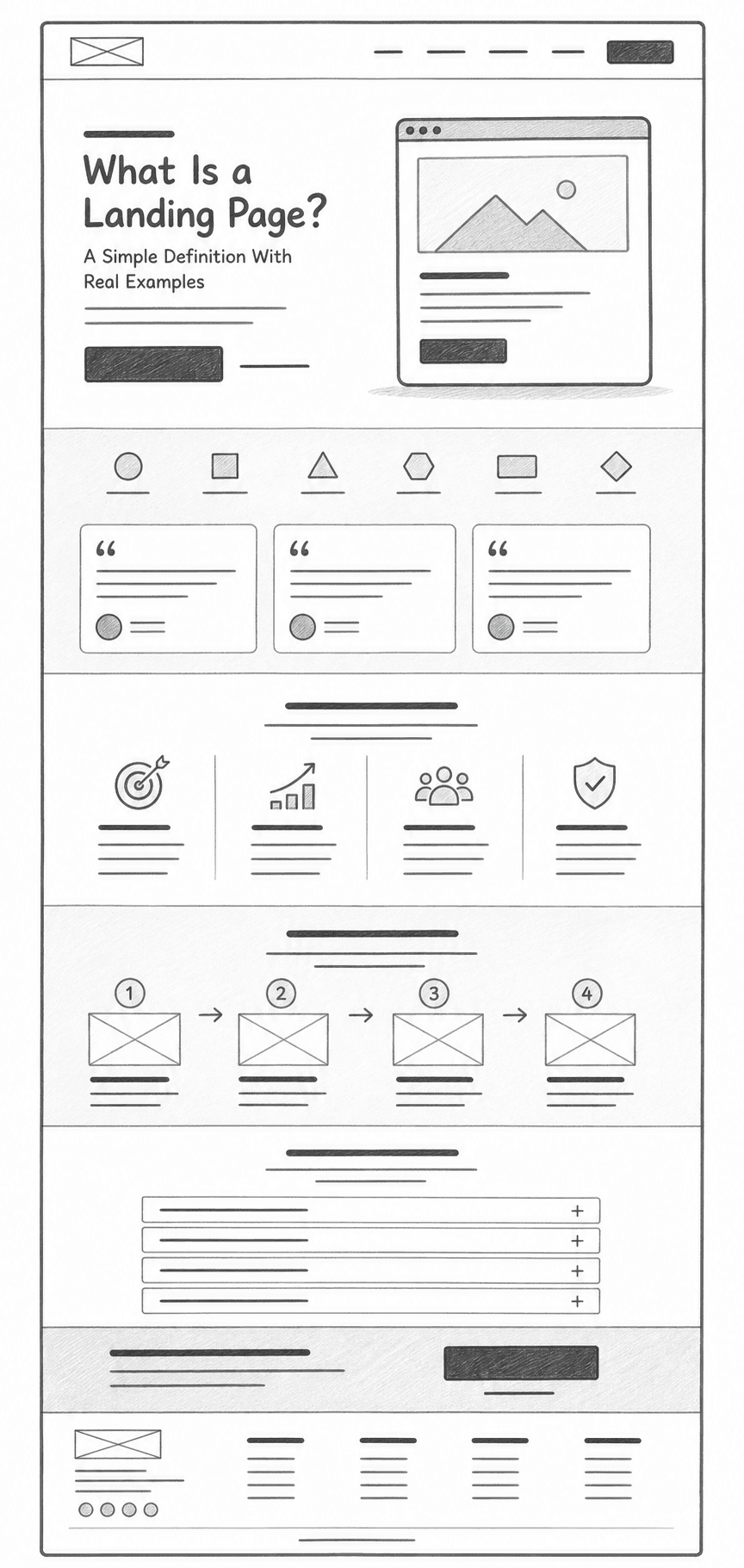
1. A hero that explains the offer fast
The hero should tell the right visitor what the page is about within a few seconds. That usually means a specific headline, a subheadline that clarifies the mechanism or deliverable, and one primary CTA.
2. Proof that lowers risk
Proof can be testimonials, customer logos, screenshots, usage counts, case-study results, ratings, or a visible product output. The format matters less than credibility and specificity.
3. Benefits and explanation
Visitors need to understand what changes for them and how the product or service works. Benefits explain the payoff. Process blocks explain the path. Good landing pages usually make both visible.
4. Objection handling
FAQs, pricing details, security notes, guarantee language, setup expectations, and support details all help visitors who are interested but not ready yet.
5. Repeated CTA placement
The CTA should appear at the natural decision points of the page, not just once at the top. Visitors become ready at different moments.
If the CTA is the weak point, the CTA guide shows exactly how to replace vague button text with clearer action-focused copy.
Read the CTA examples guideReal landing page examples by page type
Landing pages do not all look the same because the business model changes what the visitor needs before acting. What matters is not copying one visual style. What matters is keeping the page aligned to one clear conversion path.
These are common real-world landing page patterns you will see across SaaS, services, ecommerce, and lead generation.
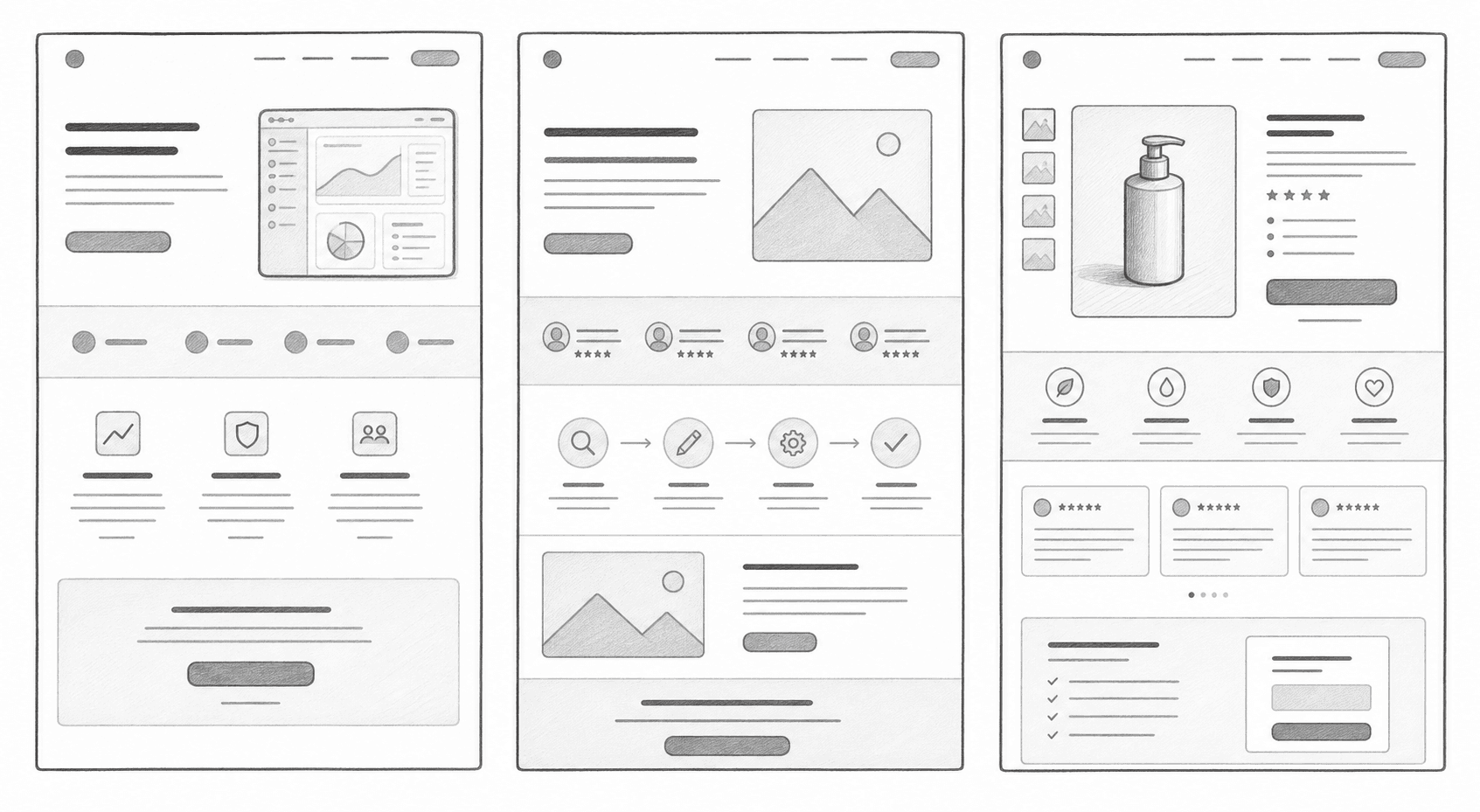
SaaS free-trial landing page
This type of page usually leads with one problem, one product outcome, and one CTA such as Start my free trial or Create a free account. Product screenshots, integration proof, and setup clarity matter a lot here because visitors want to know what they are stepping into.
Service business landing page
A service page often needs stronger credibility blocks: client proof, process steps, example outcomes, and a CTA like Book a strategy call or Request a review. The page sells trust as much as the offer itself.
Ecommerce product landing page
A product-focused landing page narrows around one item or one offer. It usually emphasizes product imagery, benefits, reviews, pricing clarity, shipping or guarantee reassurance, and a direct Buy now or Add to cart CTA.
Lead magnet landing page
This pattern exists to trade contact information for something useful: a checklist, guide, template, calculator, or teardown. The page should explain what the visitor gets, why it is valuable, and how quickly they receive it.
Landing page audit tool page
For an audit tool like Improve My Page, the landing page works best when the action and the output are obvious. Visitors should quickly understand that they paste a public URL and receive a focused report about what is hurting conversions.
Landing page vs homepage: what is the difference?
A homepage introduces the business. A landing page advances one decision.
That distinction matters because homepages usually serve several audiences at once. They link to product areas, documentation, pricing, blog content, careers, legal pages, and more. That is normal. The homepage is a map.
A landing page is narrower. It normally trims those choices down so the visitor can stay on the path that matches the source they came from. That source-to-page continuity is one of the main reasons landing pages convert better than sending all traffic to the homepage.
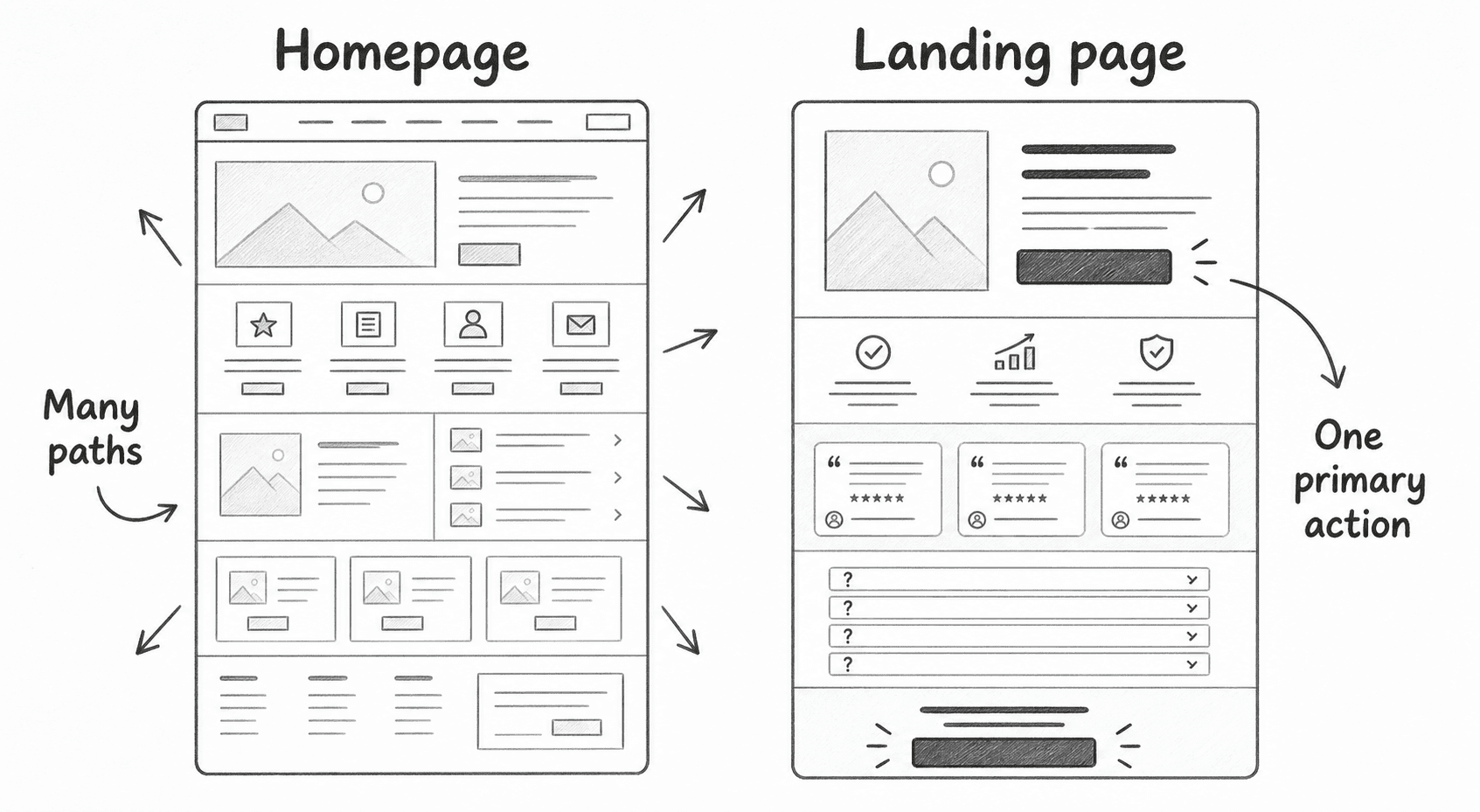
- Homepage: broad orientation, multiple routes, many audiences.
- Landing page: focused message, one main route, one audience or campaign intent.
- Homepage: better for exploration.
- Landing page: better for converting a specific click into a specific action.
Fix
If you are paying for traffic, sending that traffic to a page with too many unrelated choices often wastes attention before the visitor reaches the CTA.
What is not a landing page?
Not every page with a headline and a button counts as a landing page.
A generic homepage is not automatically a landing page. A long blog post is not automatically a landing page. A feature list with no clear next step is not automatically a landing page. Even a pricing page is not necessarily a landing page if it is trying to serve too many journeys at once.
The defining characteristic is not the URL slug or the design pattern. It is the conversion focus. If the page does not have a clear primary action, it is probably a website page with CTA elements rather than a true landing page.
How to tell if your landing page is working
A landing page can look polished and still underperform. The real question is whether visitors understand the offer and act on it.
That usually shows up in a few basic signals: does the page match the traffic source, do visitors click the primary CTA, do they abandon on mobile, does the page load quickly, and do they reach the step after the CTA?
If traffic is arriving but the page does not create movement, the most common causes are unclear messaging, weak proof, pricing friction, too many options, or technical problems that are easy to miss during design review.
- The headline matches what the ad, post, email, or search result promised.
- The primary CTA gets clicked at a healthy rate relative to page visits.
- Visitors can explain what happens after the click without guessing.
- The page loads quickly and works cleanly on mobile.
- Proof appears before most visitors need to decide.
- Pricing, form length, or setup expectations do not create avoidable surprises.
For a broader diagnostic before buying traffic, use the full landing page audit checklist.
Read the landing page audit checklistCommon landing page mistakes
Most weak landing pages do not fail because of one dramatic error. They fail because small frictions stack up until the visitor stops moving.
Fix
Before redesigning the whole page, fix the message, CTA, proof, pricing clarity, and mobile friction first. Those usually create the biggest movement.
1. A vague hero
If the headline sounds impressive but does not tell the visitor what the offer actually is, the page starts with uncertainty instead of clarity.
2. A weak CTA
Buttons such as Get started, Learn more, Submit, or Continue often hide the next step. On cold traffic, that hurts conversions.
3. Not enough proof
A landing page asks for trust quickly. If there is no credible reason to believe the claim, the visitor hesitates.
4. Pricing or offer ambiguity
If visitors cannot tell what they get, what it costs, or what commitment is required, they delay the decision or leave.
5. Too many exits
Heavy navigation, multiple equal CTAs, unrelated links, and side quests pull attention away from the page's main job.
6. Mobile and speed problems
Even a strong message underperforms when the form breaks on mobile, the CTA sits under a sticky widget, or the page feels slow.
If your page gets visits but still does not move people forward, the broader conversion article covers the usual failure points in more detail.
Read why your landing page is not convertingBasic SEO rules for landing pages
A landing page built for conversion still needs to be understandable to search engines if you want it to rank or support organic discovery.
That does not mean stuffing keywords everywhere. It means matching the page to one clear intent, using a specific title and meta description, keeping the page useful and original, and making the page easy to crawl, read, and navigate.
For this article itself, that means using the core query naturally, adding descriptive subheadings, placing helpful images near relevant text, and linking to deeper supporting guides where they genuinely help the reader.
- Match one main query and intent per page.
- Use a clear title tag, meta description, and H1.
- Keep headings and CTA text descriptive rather than vague.
- Use images that support the topic and give them useful alt text when they add meaning.
- Link to relevant supporting pages instead of isolating the content.
- Keep the mobile experience, speed, and page clarity strong enough that visitors do not bounce immediately.
Fix
SEO brings the click. Landing-page clarity converts it. Treat those as one system, not two separate projects.
Quick landing page checklist
If you need a fast answer to whether a page qualifies as a strong landing page, run this short checklist.
- The page has one primary conversion goal.
- The hero explains the offer fast.
- The CTA clearly states what happens next.
- The page includes proof before the visitor has to commit.
- Benefits and process are easy to understand.
- Objections such as pricing, setup, or trust are answered.
- The page does not overload visitors with unrelated paths.
- The mobile layout and load speed are good enough to support action.
- The page matches the traffic source promise.
- Every major section supports the same next step.
Check your own page
See whether your page is acting like a real landing page
Improve My Page audits hero clarity, CTA specificity, proof placement, pricing friction, mobile issues, speed, SEO basics, accessibility, and trust signals so you can see what is blocking conversions first.
Check your landing page nowSummary
| Problem | Diagnostic signal | Fix |
|---|---|---|
| The page tries to do too many jobs | Multiple equal CTAs, broad navigation, mixed audiences, weak message match | Reduce the page to one primary action and one clear audience promise. |
| Visitors cannot tell what happens next | Buttons say "Get started," "Submit," or "Learn more" without enough context | Rewrite the CTA so it names the action and the outcome. |
| The offer is still abstract after the hero | Headline sounds polished but does not explain the concrete result | Make the hero specific about who the page is for and what the visitor gets. |
| The page looks credible too late | Proof sits far below the fold or stays generic | Add stronger proof near the hero and before key decision points. |
| Traffic source and destination feel disconnected | Ad, email, post, or search query promise does not match the page framing | Align the headline, offer framing, and CTA with the exact source intent. |
| The page is discoverable but not usable | Weak mobile layout, slow load, poor hierarchy, or thin SEO basics | Tighten the page structure, speed, and search-facing metadata together. |
A landing page is best understood as a page with one job: move a specific visitor toward a specific action.
When that job is clear, the rest of the page becomes easier to judge. You can see whether the hero explains the offer fast enough, whether the CTA is honest enough, whether the proof arrives early enough, and whether anything technical is silently getting in the way.
That is why the practical question is not just what is a landing page. It is whether your page behaves like one.
FAQ
What is a landing page in simple words?
A landing page is a focused web page built to get a visitor to take one specific action, such as signing up, booking a demo, downloading a resource, or buying something.
Is a homepage the same as a landing page?
Usually no. A homepage serves multiple audiences and offers multiple paths. A landing page is narrower and is built around one main goal.
What should a landing page include?
Most landing pages need a clear hero, one primary CTA, proof, benefits, a simple explanation of how it works, objection handling such as FAQs or pricing clarity, and repeated CTA placement at decision points.
How many CTAs should a landing page have?
A landing page can repeat the CTA several times, but those CTAs should usually support one primary action. The problem is not repetition. The problem is competing actions.
Can a landing page rank in Google?
Yes. A landing page can rank if it matches a clear search intent, has useful original content, is technically crawlable, and gives searchers a good enough experience after the click.
Do landing pages need navigation?
Some do and some do not. The rule is not to remove navigation blindly. The rule is to avoid giving the visitor so many unrelated exits that the primary action becomes weaker.
How long should a landing page be?
Long enough to answer the visitor's key doubts before the action. A simple low-risk offer may need a short page. A higher-ticket or less familiar offer may need more proof, explanation, and objection handling.
What makes a landing page convert better?
Clear positioning, strong message match, specific CTA copy, believable proof, pricing clarity, mobile usability, and enough trust for the visitor to feel safe acting now.