Anatomy of a Landing Page: Every Section You Need to Convert Visitors
A high-converting landing page is not random. Here is the anatomy section by section, what each block needs to do, the order that works, and where pages usually lose visitors.
Most landing pages do not underperform because they look bad. They underperform because the page is missing one of the sections a visitor needs before they are ready to act, and most of the time nobody notices what is missing because the page still feels complete.
Landing page visitors arrive carrying a set of quiet questions they need answered in a particular order: am I in the right place, is this offer actually for me, why should I believe this claim, what happens after I click, what does it cost, and is there a catch?
The anatomy of a landing page is really a map for answering those questions in the right sequence before they turn into reasons to leave. When the structure does that job well, the page feels obvious. When one section is weak or missing, clicks stall even if the design looks polished and the copy sounds confident.
This guide breaks down each section of a high-converting landing page, what job it does, what executing it well looks like, where teams commonly get it wrong, and how to tell whether your own page is missing something important.
Why landing page anatomy matters
A landing page is not a collection of blocks arranged for visual balance. It is a conversion path, and each section in that path has a specific job to do at a specific moment in the visitor's decision process.
The hero creates initial clarity. Proof reduces the risk of being wrong. Benefits build desire for the outcome. A process section makes the next step feel manageable. FAQs and pricing remove hesitation. Repeated CTAs catch visitors when they are actually ready.
When one of those jobs is missing, the visitor hits a gap. They have to do extra mental work to fill it in, whether that means inferring the price, guessing the setup process, or wondering whether anyone else has actually used the product. That extra work is where drop-off usually starts.
Fix
Do not ask whether the page looks complete. Ask whether the visitor gets every answer they need before they are asked to act.
The core sections every landing page needs
Not every page needs the same visual treatment, and not every section needs the same depth. But most high-converting landing pages across SaaS, services, ecommerce, and lead generation rely on the same structural jobs.
What changes is how much space and evidence each section needs based on the offer, the price point, and how well the visitor already knows the category. Below is the anatomy that works for most of them.
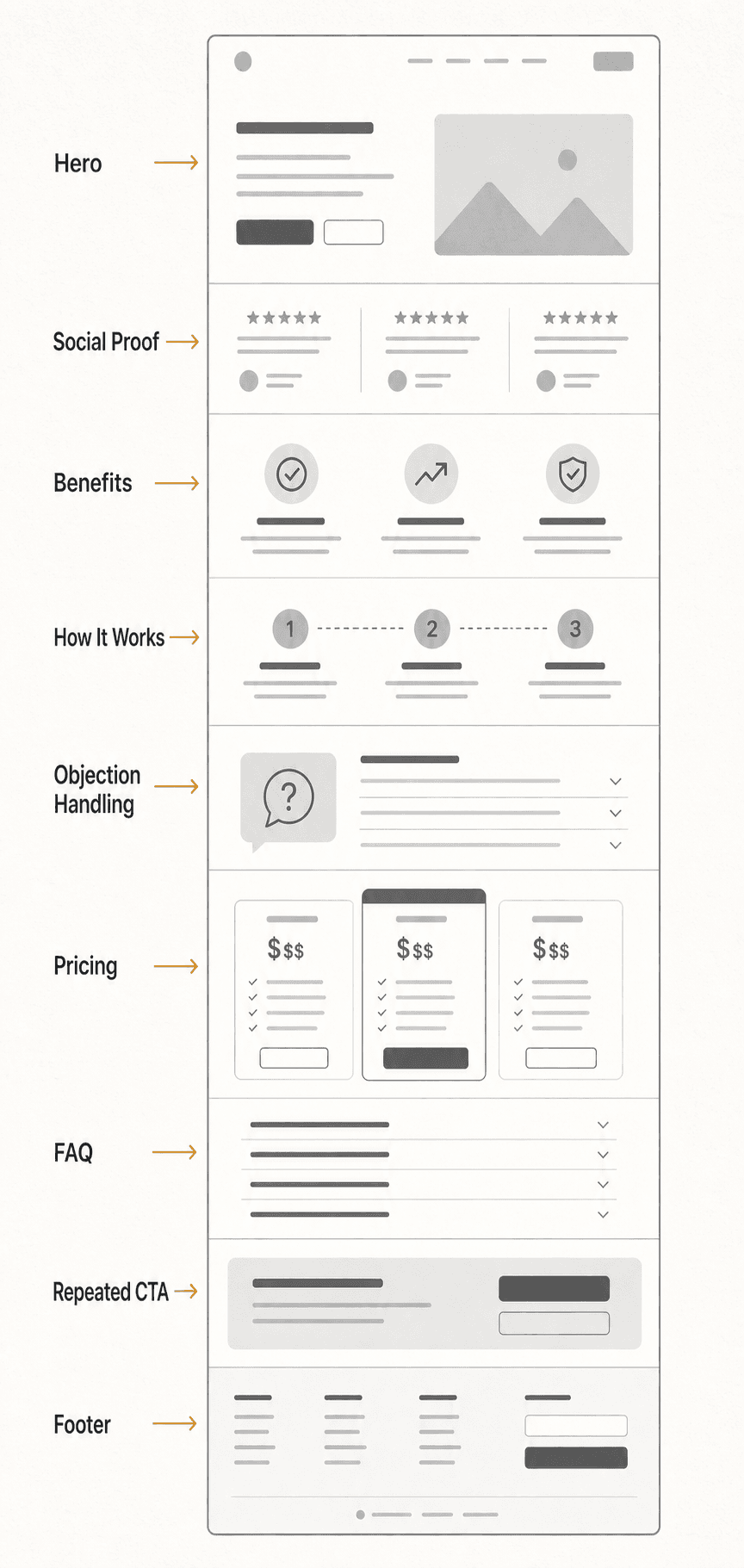
1. Hero section
The hero is where the decision to keep reading or not gets made. In the first few seconds, visitors are answering one question: is this relevant to me? If the hero cannot answer that quickly, most of the rest of the page never gets seen.
A strong hero usually includes a headline that names the audience and the outcome, a subheadline that clarifies the mechanism or what the visitor actually gets, one primary CTA that says what happens next, and either a product visual, a proof cue, or an output preview that makes the offer feel real rather than abstract.
The common failure here is not bad writing. It is writing that sounds polished but stays too vague. A cold visitor should not have to decode the page before deciding whether to continue.
- State the outcome, not just the product category.
- Make the CTA specific about what happens after the click.
- Keep the message aligned with whatever the traffic source promised.
Fix
If the hero sounds clever but still leaves the visitor asking what the product or service actually does, rewrite it until the value is obvious in a few seconds.
3. Benefits section
The benefits section answers the practical question every visitor is asking: what actually gets better for me if I say yes? This is where the page needs to translate product facts into buyer outcomes.
The common error is stopping at feature labels. Product capabilities describe what the tool does. Benefits describe what changes in the buyer's situation because of it.
Good benefit sections focus on the problems that disappear, the gains that become possible, and the speed or ease of getting there.
- Lead with outcomes the buyer already cares about, not features they have to learn to value.
- Keep each benefit tied to one specific pain or desire.
- Use enough supporting detail that the claim feels grounded, not just aspirational.
Fix
If the benefits section could belong to any competitor in the category, it is too generic. Rewrite it around the actual before-and-after change your product creates.
4. Features or product explanation section
After benefits create desire, many visitors want to understand how the promise is actually delivered. This section explains the mechanism, the product capabilities, the deliverables, or the scope of what is included.
For a software product, this might be screenshots, audit categories, integrations, or a walkthrough of the workflow. For a service, it might be deliverables, access level, timelines, or what the engagement actually includes week by week.
The failure mode here is replacing explanation with marketing language. Concrete specifics help a visitor understand what they are stepping into.
Fix
If a visitor would still have to guess what is included after reading this section, the explanation layer is too thin. Make the mechanism visible.
5. How it works or process section
The process section's job is to make the next step feel manageable. It reduces perceived effort by showing what happens first, second, and third, and by removing mystery around setup, timing, and how quickly the visitor gets to value.
This matters most when the offer could feel complex, technical, expensive, or time-consuming. A simple, visible path makes the action feel lighter.
For an audit tool, a clear three-step framing such as paste a URL, get a prioritized report, fix the top issues makes the action feel much more manageable than a generic Start now button on its own.
- Keep the process short and concrete, usually three to five steps at most.
- Name the very first step explicitly so the visitor can picture it.
- Remove mystery around timing, especially how long the first result takes.
Fix
If a visitor cannot picture the first few moments after clicking the CTA, a clearer process section is usually what is missing.
6. Objection handling section
Interested visitors still hesitate. Objection handling closes the gap between this looks relevant and I am ready to act.
It answers the doubts that stop action: price sensitivity, setup effort, fit uncertainty, trust concerns, security questions, support expectations, cancellation terms, and anything that could feel like a hidden catch.
This section can appear as short trust bullets, a structured FAQ, a guarantee block, a comparison table, or a plain-language setup note. The format matters much less than whether the real hesitations actually get answered.
- Address the expensive questions directly, including what happens if I cancel, who handles my data, and what is not included.
- Answer fit concerns before the visitor has to ask whether this is for their industry, team size, or use case.
- Use plain language instead of defensive or evasive marketing copy.
Fix
If you keep hearing the same objection in sales calls, emails, or demos, that objection belongs on the page.
7. Pricing or offer section
Not every landing page needs a full pricing table, but every landing page needs offer clarity. By the time a visitor reaches this section, they should be able to answer what they get, what it costs or commits them to, and whether there are important limits they should know about.
For some pages that means a visible price and plan structure. For others it means a free-trial explanation with a clear end date, a qualification note about who the service is right for, a minimum contract size, or a simple call-to-book CTA instead of pretending commercial reality does not exist.
When visitors cannot tell whether they are entering a free tool, starting a paid subscription, or booking a sales call, uncertainty rises fast.
Fix
If the price or commitment feels like a surprise after the click, the page has delayed friction instead of removing it. Clarity before the action usually converts better than clarity after.
8. FAQ section
The FAQ section handles the questions that are too specific to dominate the main sections but too important to leave unanswered. Done well, it is one of the most effective objection-handling tools on the page, especially for visitors who are close to deciding but stuck on one practical concern.
Strong FAQs usually cover setup time and technical requirements, who the offer is and is not right for, what happens immediately after signup, refund or cancellation policies, pricing edge cases, data handling, and whether the tool makes automatic changes to the page.
A good FAQ also helps reinforce topic coverage for search without turning the page into a bloated article.
Fix
A good FAQ is not filler. It is structured objection handling for visitors who are almost there. If yours reads like a legal document, rewrite it in plain language.
9. Repeated CTA section
Different visitors become ready to act at different moments in the page. Some decide after the hero. Some need proof first. Some read through the FAQ before they click anything.
A page with a single CTA at the top forces everyone to decide at the same moment, which is the wrong moment for many of them. The CTA does not need new wording each time, but it does need to be present after the major decision blocks.
Fix
Repeat the primary CTA at natural readiness points. The problem is not repetition. The problem is competing actions that split attention.
For broader context on what a landing page is supposed to be and do before getting into anatomy, the definition guide covers that foundation.
Read what a landing page isA simple order that works for most landing pages
Most pages do not need a clever or novel structure. They need a clear one. A strong default order for most landing pages is hero, proof, benefits, product explanation or screenshots, how it works, objection handling and FAQ, pricing or offer clarity, then a final CTA.
That order is not arbitrary. It follows the natural progression of a visitor's thinking: first orientation, then belief, then desire, then certainty, then a clean path to act.
Skipping steps in that sequence is where many conversion problems actually live, such as leading with pricing before value is understood or jumping into features before proof has established credibility.
- Hero: explain the offer, the audience, and the next action.
- Proof: show why the claim is credible.
- Benefits: make the outcome genuinely desirable.
- Explanation: show how the promise is actually delivered.
- Process: make the next step feel manageable, not daunting.
- Objections and FAQ: remove the hesitations that stop action.
- Pricing or offer clarity: prevent commitment surprises.
- Final CTA: capture readiness once the page has earned it.
Fix
If the page jumps into detailed explanation before the visitor understands the core promise, try reordering before rewriting. Structure is often the fix, not copy.
What changes based on the type of offer
The anatomy stays similar across different page types, but the weight of each section shifts depending on what the visitor is being asked to do and how much it costs in money, time, or trust.
Fix
Do not copy another page's layout blindly because it looks good or seems authoritative. Keep the same section jobs, but adjust the depth based on actual risk, price, and buyer intent.
SaaS and free-trial pages
These pages usually need strong hero clarity about the specific outcome, product screenshots that show what the visitor is actually stepping into, setup reassurance so the free trial does not feel like a commitment, integration proof for the tools they already use, and friction-reducing CTA copy that names the action clearly.
Service and lead-generation pages
These pages carry a higher perceived commitment. They usually need heavier trust signals, stronger process detail that makes the engagement feel predictable, clearer fit signals about who the service is and is not right for, and better objection handling around pricing ranges, timelines, and deliverables.
Ecommerce and product-offer pages
These pages tend to rely more heavily on visual proof, review density, and specificity of outcome. Pricing clarity, guarantee language, shipping or return reassurance, and CTA repetition near product-detail sections matter a lot here.
Common section mistakes that block conversions
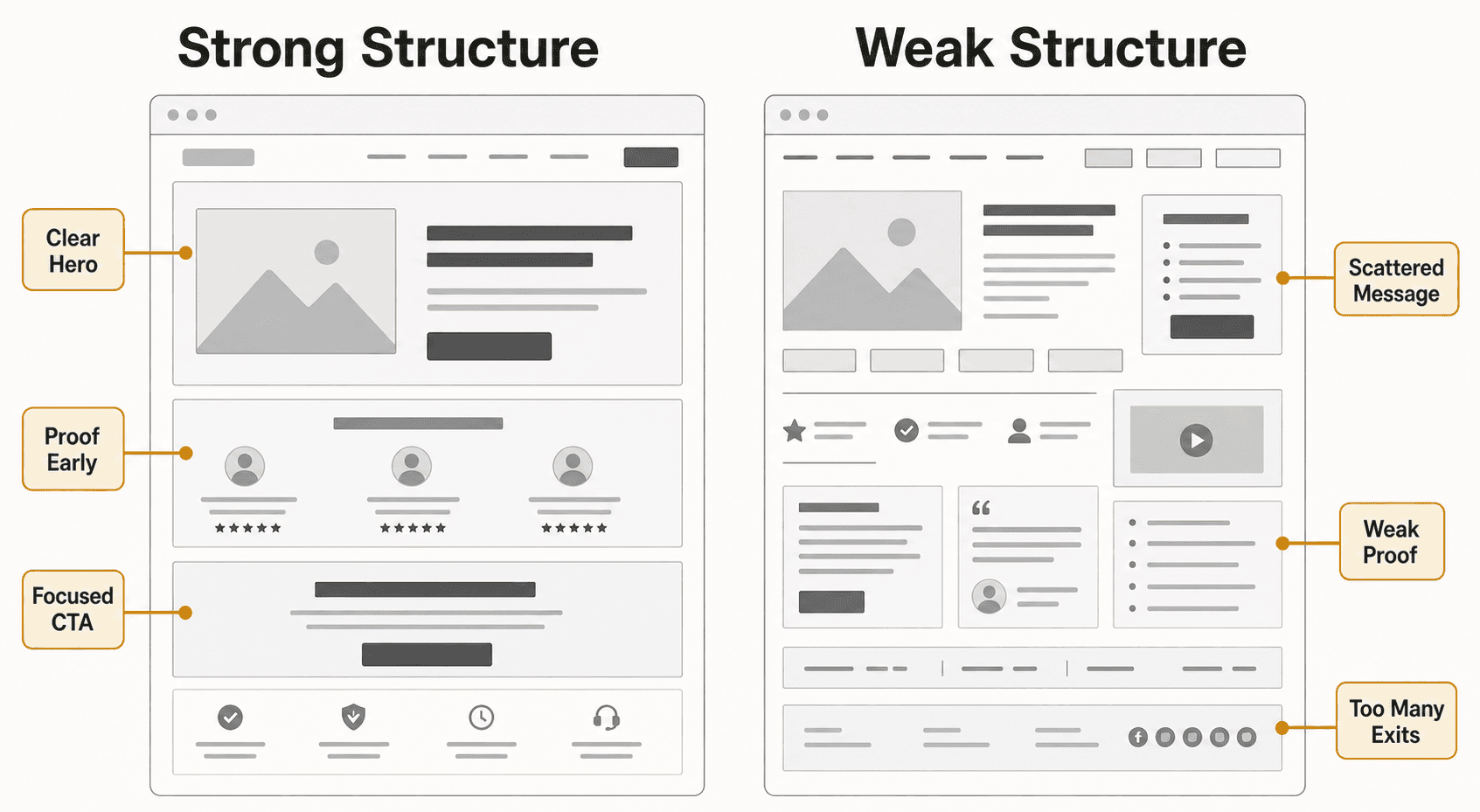
Most landing pages that underperform are not missing sections entirely. They contain the right sections in name but the wrong execution in practice, and the problems are often subtle enough that they do not announce themselves.
The hero does not match the click source
If the ad, email, post, or search result promises one thing and the page opens with something broader or vaguer, visitors lose confidence immediately.
This issue affects every visitor before anything else on the page can do its job, which is why it is often more important than tweaking a lower section first.
Proof appears too late
Skeptical visitors make a provisional decision about the page before they scroll very far. If proof only appears after a feature list and a benefits section, the visitors who most needed reassurance may already be gone.
Moving the strongest and most specific proof element directly below the hero is often one of the simplest structural improvements you can test.
Benefits sound like category filler
Words like seamless, powerful, effortless, or innovative appear in the benefits sections of almost every software category. Repeated often enough, they stop feeling like claims and start feeling like background noise.
Benefits that name a specific before-and-after change are the ones that actually build desire.
The next step feels unclear or heavy
A weak process section or no process section at all forces visitors to imagine what happens after the click.
That imagination usually becomes more pessimistic than the reality. Making the first step concrete and the second step visible removes a lot of that imagined friction.
The commercial reality is vague
When visitors cannot tell whether they are entering a free tool, starting a trial, booking a call, or buying a report, they usually do not ask. They leave.
Ambiguity about price and commitment may feel safer than stating the truth, but it often creates more hesitation than it removes.
If the page already gets traffic but still stalls before conversion, the conversion-diagnosis guide goes deeper into the specific frictions that stop action after the click.
Read the conversion diagnosis guideHow this structure helps SEO as well as conversions
A well-structured landing page does not just work better for visitors. It is also easier for search engines to read, understand, and match to the right queries.
Clear H1 and H2 headings, a FAQ section built around questions the audience actually searches for, a coherent topic focus across sections, descriptive alt text on meaningful images, and internal links to supporting guides all help the page stay easier to interpret.
The practical implication is that strong landing page anatomy and strong SEO are not naturally in tension. A page structured to answer visitor questions in the right order is also a page structured to satisfy search intent.
For a practical review pass before pushing more traffic, use the landing page audit checklist.
Read the audit checklistAudit your structure
See which landing page sections are helping or hurting conversion
Improve My Page reviews hero clarity, CTA specificity, proof placement, pricing friction, mobile issues, page speed, SEO basics, accessibility, and trust signals so you can see where your page structure is likely breaking down first.
Run a landing page auditSummary
| Problem | Diagnostic signal | Fix |
|---|---|---|
| The page is missing a key decision-making section | Visitors understand part of the offer but still hesitate before acting | Add the missing section job: proof, process, objection handling, pricing clarity, or FAQ. |
| The hero does not carry enough clarity | Visitors need to scroll before they understand what the page is offering | Rewrite the hero so the outcome, audience, and CTA are obvious immediately. |
| Trust arrives too late | Proof is generic, buried, or disconnected from the action | Move stronger proof closer to the hero and to the major decision points further down the page. |
| The page explains features without building desire | The content lists capabilities but does not connect them to buyer outcomes | Turn features into concrete benefits before explaining the mechanism. |
| The next step feels unclear or heavier than it is | The page hides what happens after the click, what it costs, or how setup works | Add a process section and an offer-clarity section that remove the guesswork. |
| The CTA is present but readiness is not captured | There is only one CTA, or there are several competing CTAs pointing at different things | Repeat one primary CTA after each key section instead of splitting the page into multiple conversion paths. |
The anatomy of a landing page is not about following a fashionable template. It is about making sure the visitor gets each answer they need in the right order before they are asked to do something.
When the hero is clear about who the page is for, the proof is specific enough to be believable, the benefits describe a real before-and-after, the process makes the next step feel simple, and the objections are answered before the visitor has to ask, conversion starts to feel like the natural conclusion rather than a leap of faith.
If your page is getting attention but not enough action, the fix is usually not more traffic or a full redesign first. It is identifying which section is not doing its job and fixing that before scaling what is already leaking.
FAQ
What are the main sections of a landing page?
Most landing pages need a hero, a social proof section, a benefits section, a product explanation or feature section, a how-it-works section, objection handling, pricing or offer clarity, a FAQ section, repeated CTAs at natural decision points, and a trust-supporting footer.
The exact number of sections depends on the complexity of the offer and how much the visitor needs to understand before they feel ready to act.
What section should come first on a landing page?
The hero section should come first because it has to answer the visitor's first question, is this for me, quickly enough that they decide to keep reading.
If visitors do not understand the page within the first few seconds, the rest of the structure rarely gets the chance to do its job.
Do all landing pages need testimonials?
Not testimonials specifically, but almost all landing pages need some form of credible proof.
Depending on the product and stage of the business, that might be customer logos, usage counts, review badges, case study results, or a visible example of the product's output.
How many sections should a landing page have?
There is no correct number. The right answer is enough sections to create clarity, build trust, make the outcome desirable, reduce perceived effort, remove hesitation, and give the visitor a clean path to act.
The offer complexity and the buying risk are the main factors that determine how much space each job needs.
Should pricing be on a landing page?
Usually yes, or at least the page should make the commercial reality clear. Visitors who do not understand the commitment they are making before they click often convert less cleanly than visitors who know what they are stepping into.
Offer clarity before the action tends to work better than offer clarity after it.
Can a landing page be too long?
Yes, if it adds repetition without resolving more doubt. But it can also be too short if it asks for action before the visitor has enough clarity, credibility, and confidence.
The right length is whatever it takes to move a cold visitor from arrival to confident action, without piling on sections that repeat the same job.
What's the most important section on a landing page?
The hero matters most at the very start because it determines whether any other section gets read at all.
But in practice, the most important section is the one currently creating the most drop-off. If clicks stall after the feature section, the issue may be the explanation layer or a missing process block rather than the hero itself.
How do I know which section is causing my landing page to underperform?
Heatmaps and session recordings can show where visitors scroll, click, and stop engaging. Analytics funnels can show where drop-off concentrates.
A manual review or a tool-based audit helps surface structural gaps that click data alone does not explain. The landing page audit checklist is a useful systematic pass before you buy more traffic.
2. Social proof section
Social proof does something the hero copy cannot: it shows that people other than the seller believe the offer is worth it. It lowers the fear of being the first to trust an unfamiliar claim or the fear of being wrong about the decision.
This section can take many forms: testimonials, customer logos, usage counts, review snippets, case study results, third-party mentions, or a visible product output that demonstrates the tool works. The format matters less than specificity.
Where this section usually fails is placement. Many pages bury proof below the fold after a feature list or benefit grid, which means the visitors who most need reassurance never reach it.
Fix
If your proof says things like great product or highly recommend without context, it is too weak to reduce real buying risk. Specific beats enthusiastic.